Choosing a dining table in 2026 involves more than matching a room’s color palette. Shape affects conversation, seating capacity, circulation, cleaning, and everyday comfort. A round table can soften a narrow room, while a rectangular table often uses wall space more efficiently. The difference becomes obvious when chairs pull back, children move around, or guests arrive unexpectedly.
Recent industry research supports a practical approach. The 2024 Houzz & Home Study shows that homeowners continue investing in functional improvements, not decoration alone. IKEA’s Life at Home Report 2024 also emphasizes the importance of shared meals and meaningful time at home. Meanwhile, the U.S. Bureau of Labor Statistics Consumer Expenditure Survey tracks continued household spending on food and home living. These reports do not declare one table shape superior. They reveal a more useful point: dining furniture must support real routines.
So, what are the pros and cons of round vs rectangular dining tables? This guide examines both options through space planning, ergonomics, durability, and hosting needs. A round table may encourage eye contact and eliminate sharp corners, but it can waste space in a long room. A rectangular model may seat more people and fit expandable designs, yet its corners can restrict movement. Measurements matter more than trends.
Small details matter.
We will consider table diameter, walkway clearance, chair placement, and material performance. The recommendations combine design principles, manufacturer specifications, and practical household experience. Still, no layout formula is perfect. A beautiful table can feel awkward if daily habits were ignored. Expect trade-offs, not a universal winner.
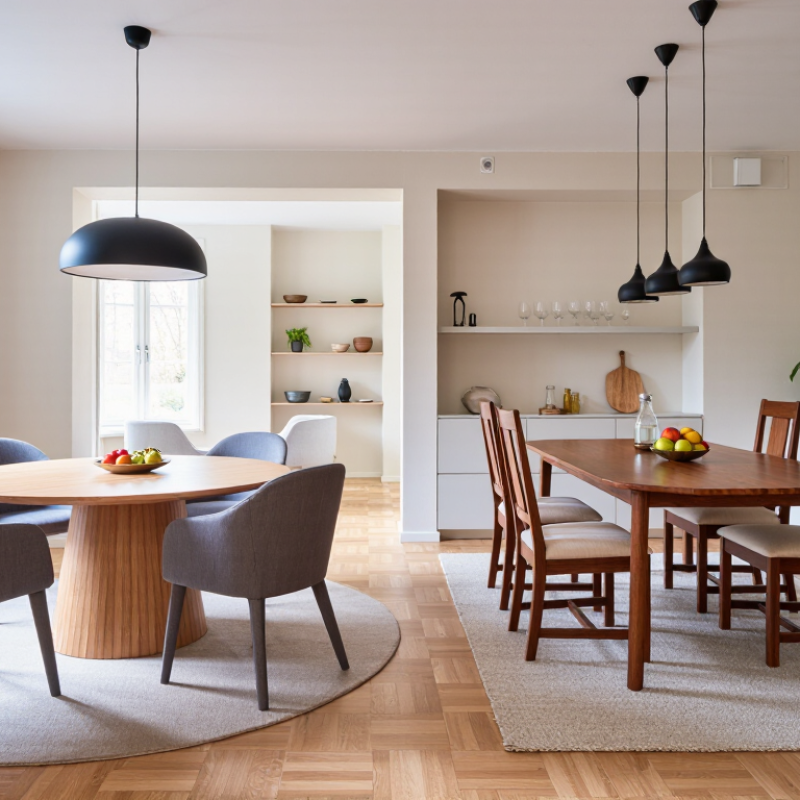
Round vs. Rectangular Dining Tables: Key Design Differences
Round and rectangular dining tables create very different visual and practical experiences. A round table softens a room with curved edges and encourages equal conversation. Nobody sits at an obvious “head” position. It also works well in compact dining areas, especially when chairs can slide fully underneath. However, a large round top may force guests to reach across plates. Its central base can improve legroom, but some pedestal designs feel less stable.
Rectangular tables offer clearer structure. Their long shape suits narrow rooms and aligns easily with walls, windows, or kitchen islands. They provide efficient seating for families and can handle serving dishes along the center. A rectangular table may also extend for larger gatherings. Yet, corner seats can feel separated from the conversation. Sharp corners deserve attention in homes with active children. I once chose a rectangular table for a small room, assuming its straight lines would save space. The corners actually restricted movement. That judgment was wrong.
Tips: Mark the tabletop with painter’s tape before buying. Leave about 90 centimeters for comfortable chair movement. Measure doorways, too. For round tables, check the diameter against your serving habits. For rectangular tables, compare the length with walking paths. A lighter finish can reduce visual heaviness, while a sturdy surface handles daily scratches better. Recheck your measurements. Rooms often look larger on paper.
2026 Best Round vs. Rectangular Dining Tables: Key Design Differences
Typical tabletop footprint by seating capacity
Rectangular tables generally provide more usable linear seating and fit narrow or elongated rooms efficiently. Round tables create equal sightlines and a more conversational layout, but their circular footprint usually requires slightly more floor area at comparable seating capacities. The figures show typical planning dimensions: rectangular tables of 48×30, 72×36, and 96×40 inches, compared with round tables measuring 48, 60, and 72 inches in diameter. Footprint areas are calculated geometrically and actual furniture dimensions may vary.
How Round and Rectangular Tables Affect Space and Seating
Round and rectangular dining tables change a room’s movement, not just its appearance. A round table softens tight corners and creates clearer sightlines across compact dining areas. Without sharp corners, people can pass more easily around the table. This matters in apartments, where a chair may sit near a doorway or kitchen path.
A 42- to 48-inch round table usually seats four people comfortably. A 54- to 60-inch version can seat six, depending on chair width. A central pedestal often gives knees more freedom than four corner legs. Rectangular tables use walls and narrow rooms efficiently. A 60-by-36-inch table commonly seats six, while a 72-inch table can support six to eight diners. Allow about 24 inches of table edge per person. Keep roughly 36 inches behind occupied chairs for comfortable movement.
In real homes, these measurements can mislead. I once planned a round table that fit on paper, but opened chair backs blocked a cabinet. Chair shape, table thickness, and daily clutter matter more than a floor plan suggests. Rectangular tables offer better serving space and easier extension for guests. However, their corners can interrupt traffic and feel heavy in small rooms. Round tables encourage conversation, yet serving dishes may crowd the center. Test the layout with taped floor lines and borrowed chairs before buying. Small mistakes become obvious when someone carries a hot dish.
Comparing Comfort, Conversation, and Accessibility
Round and rectangular dining tables create different social experiences, especially when comfort and conversation matter. A round table keeps everyone equally close, so faces stay visible and voices travel easily. Conversation feels natural. There is no obvious head seat. This layout can feel welcoming in compact dining rooms, where people often squeeze past chairs. However, a large round table may force guests to lean forward. Plates and shared dishes can also sit frustratingly far away.
Rectangular tables offer clearer personal space and better seating capacity along a wall. Their straight edges suit narrow rooms and allow easier furniture placement. Guests usually have more room for elbows, laptops, or children’s activity materials. Yet conversation becomes uneven at longer lengths. Someone near the center may struggle to hear a guest at the opposite end. A practical spacing target is about 90 centimeters around the table, supporting safer movement and easier chair access.
Accessibility requires more than choosing rounded corners. A round table can provide flexible approach angles for wheelchair users, but its central pedestal must leave enough knee clearance. Four-legged rectangular tables may block footrests or reduce turning space. Check the table height, apron, base position, and chair weight before buying. Small details matter. I have seen attractive tables become uncomfortable because the base collided with guests’ knees. That mistake is easy to repeat. Measure the room with chairs pulled out, not tucked in. Also test reach distance; convenience on paper may feel different during a real meal.
Advantages and Disadvantages of Round Dining Tables
Round dining tables create a softer, more social setting than rectangular designs. Their curved edges remove sharp corners, which helps in compact homes and busy family kitchens. Everyone can see each other without leaning across a corner. A pedestal base also gives knees more freedom. This matters when four adults share a small table. In my experience, conversation feels easier around a 120-centimeter round top. The center remains reachable. Plates still need careful placement.
The same shape can waste wall space. A round table leaves awkward gaps beside cabinets, benches, or narrow rooms. It usually seats fewer people along its footprint than a rectangular table. Six diners may feel crowded around 150 centimeters, especially with wide chairs. Extension mechanisms can also be less convenient. Some round tops become oval, while others require storing separate leaves. I once measured only the tabletop and forgot chair clearance. That mistake made the walkway uncomfortably tight.
For reliable planning, allow roughly 90 centimeters between the table edge and walls or furniture. Measure the full chair movement area, not just the tabletop. Choose a stable base, because a narrow pedestal may wobble on uneven flooring. Families with young children should check edge height, base stability, and wipe-clean finishes. Renters may value the social layout, but frequent hosts might prefer rectangular flexibility. I would test the arrangement with cardboard first. It reveals problems quickly. Yet even this test cannot predict how bulky dining chairs will feel after a long meal.
Advantages and Disadvantages of Rectangular Dining Tables
Rectangular dining tables remain a practical choice for homes that host family meals, homework, or frequent guests. Their long surface fits narrow rooms well and aligns naturally with walls, windows, and kitchen islands. A 60-inch table usually seats four to six people, while an 84-inch model can accommodate six to eight, depending on chair width. The U.S. Census Bureau reports an average household size of 2.59 people for 2019–2023, so many households may not need a large table every day.
Space efficiency is a major advantage.
A rectangular table can be pushed against a wall during ordinary meals, then moved outward for entertaining. It also offers clearer personal zones, which helps when serving shared dishes or placing laptops. The National Kitchen & Bath Association’s 2024 Design Trends Report continues to identify multifunctional kitchen and dining areas as an important planning direction. That supports flexible table layouts, but it does not mean every room suits a rectangle.
There are drawbacks.
Sharp corners can obstruct narrow walkways, especially around children or older adults. A long table may also create distance between diners, making conversation feel uneven.
Allow at least 36 inches between the table edge and nearby walls or furniture; 42 to 48 inches feels more comfortable for active circulation.
This measurement is often underestimated. I have seen attractive tables make a room feel cramped because visual appeal replaced movement testing. Marking the footprint with tape for one evening is a simple, imperfect, but reliable check.
Conclusion
Choosing between round and rectangular dining tables depends on your room layout, seating needs, and preferred dining experience. Round tables create a softer, more intimate atmosphere, encourage eye contact, and can make compact spaces feel less crowded because they have no sharp corners. They are often comfortable for conversation and flexible seating, but they may offer less usable surface area and can be difficult to place against a wall. Rectangular tables, by contrast, make efficient use of long or open rooms, provide clear seating arrangements, and usually offer more tabletop space for large families, meals, or gatherings. However, their corners may limit movement, and guests seated at opposite ends may find conversation less natural.
When considering “What are the pros and cons of round vs rectangular dining tables,” think about accessibility, circulation, and the number of people you regularly host. Round designs suit social, space-conscious settings, while rectangular options are practical for structured seating and entertaining larger groups. The best choice balances comfort, proportion, functionality, and the overall style of your dining area.

 Q-Flow Home